Service Dogs in Training in Connecticut: Do They Have Public Access?
This page explains the law in general terms. It is not legal advice. For a specific situation, contact the agency listed on this site or an attorney.
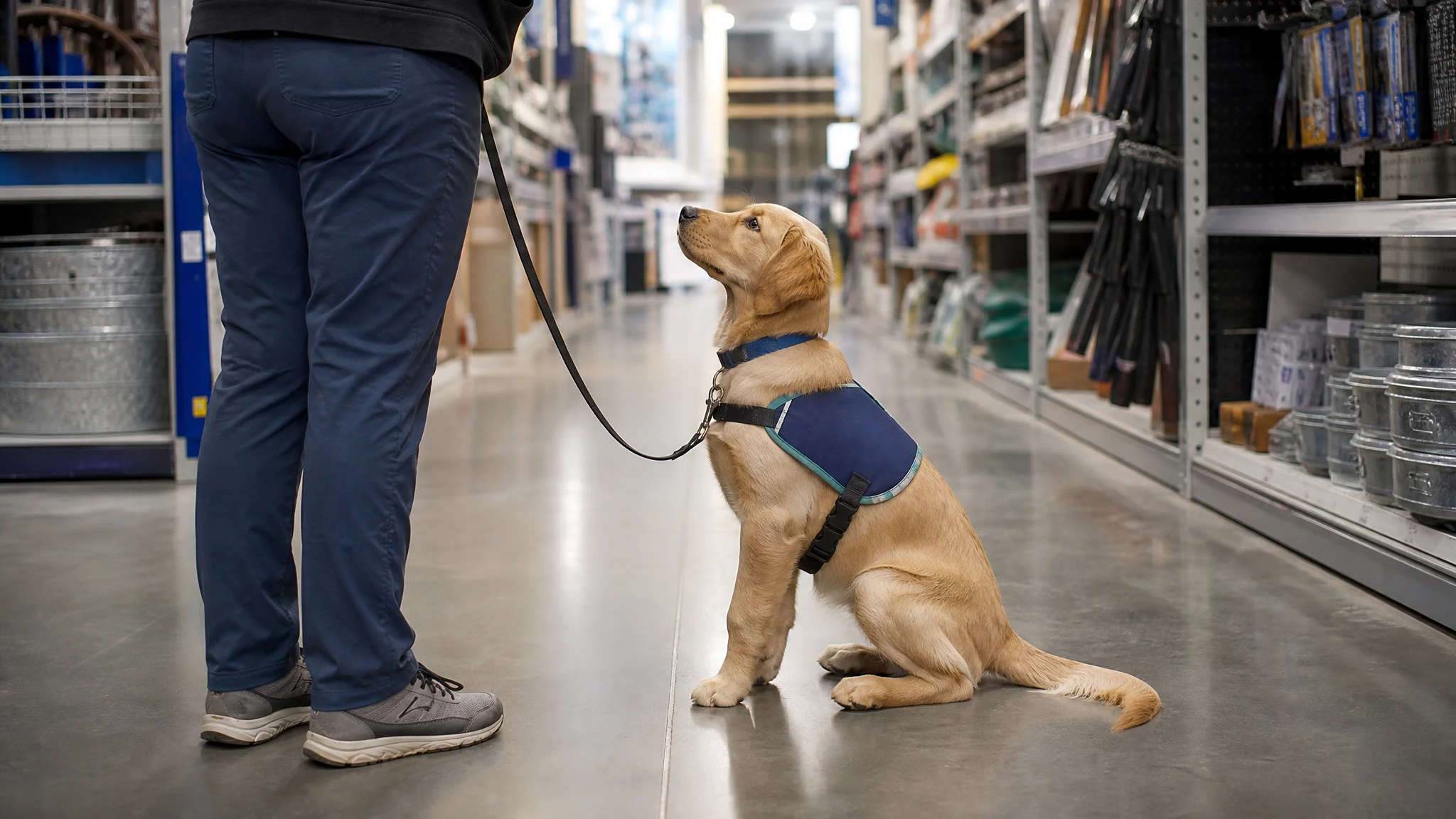
Many people who train a service dog start with one question: can the dog come into stores, restaurants and offices while it is still learning? In Connecticut the answer depends on who you are. Some trainers and volunteer raisers have a legal right of access. A private handler training their own dog does not appear to be covered by the same rule.
This guide walks you through how to work out where you stand, step by step, and what to do in each case. It explains the law in plain English. It is not legal advice.
The short answer
The federal Americans with Disabilities Act (ADA) protects service animals, and ADA.gov defines a service animal as a dog that has been individually trained to do work or perform tasks for an individual with a disability. That protection is for the working service dog of a person with a disability. The ADA does not give public access rights to dogs that are still in training.
Connecticut adds something the ADA does not. Under Conn. Gen. Stat. 46a-44, published by the Connecticut General Assembly, access rights extend to a person training an animal as a service animal to assist a person with a disability. But the statute limits that to two groups, and neither is simply "anyone who is training a dog."
What Connecticut law says about dogs in training
Section 46a-44 covers service animals on public transportation and in places of public accommodation. For a person with a disability, the Connecticut General Assembly's text says the person may enter with a service animal and keep it with them at all times at no extra charge, as long as the animal stays in the person's direct custody and control.
Connecticut also defines "service animal" by pointing to the federal ADA regulation, 28 CFR 35.104. The state definition also covers an animal in training to become a service animal.
For people who train, section 46a-44(a)(2) names two groups:
- An employed trainer. This is a person employed by an organization that trains service animals, who meets the organization's professional association membership criteria, is authorized for designated training activities, and carries photo identification showing both employment and authorization.
- A volunteer raiser. This is a volunteer for an organization that trains service animals and authorizes volunteers to raise them.
Both groups are tied to an organization. The statute does not describe a general right for a private individual who is training a dog alone, or with a private trainer who is not part of such an organization.
What you need before you start
- Your role: are you an employee of a training organization, a volunteer raiser for one, or a private handler?
- If you work or volunteer with an organization: its written authorization and, for employed trainers, your photo ID showing employment and authorization.
- A copy of Conn. Gen. Stat. 46a-44 from the Connecticut General Assembly website, for reference.
- A current town dog license and tag (see step 6).
- A well-fitted, humane flat collar or harness and a standard leash for training. Reward-based training supplies such as small treats and a treat pouch also help.
- A short list of places you want to practice, with the name of someone at each who can give permission.
Step-by-step: finding out whether your dog in training has access
Step 1: Decide which category you fit
Start with honesty about your situation. Connecticut's training provision is written around organizations. If you are an employee or an authorized volunteer of one, you may be covered. If you are an individual handler training your own dog for your own disability, the statute text does not name you as covered while the dog is in training.
If you are not sure which group you fit, do not guess. Ask the organization in writing what it authorizes, or contact the Connecticut Commission on Human Rights and Opportunities (CHRO) with questions.
Step 2: If you work or volunteer with an organization, get the paperwork in order
The statute describes conditions for each group. Employed trainers need authorization for designated training activities and photo ID showing employment and authorization. Volunteer raisers need to be raising the dog for an organization that authorizes volunteers to do so.
Ask your organization exactly what it provides and what it expects you to carry. Some Connecticut-area nonprofits that train assistance dogs include ECAD in Torrington, Forever In My Heart Foundation in Rocky Hill, The Exceptional Sidekick Service Dogs in Newtown and Fidelco Guide Dog Foundation in Bloomfield. Whether any of them authorizes volunteer raisers, and what documents it issues, is something to confirm directly with that organization. Costs and waitlists also vary, so check with each one.
Step 3: Know what the statute does not say
The text of section 46a-44 as read here does not set an age requirement for the dog. It does not list required vests, tags or gear for a dog in training. If an organization requires a particular vest or ID for its trainers or raisers, that is the organization's own rule. For anything the statute does not spell out, check with the organization or CHRO instead of assuming.
It also helps to know what Connecticut does not have. The sources reviewed show no state registry, ID card or certification for service dogs. The only state-level step found is the ordinary dog license (step 6). A vest or an online certificate does not create legal access.
Step 4: If you are a private handler, ask permission first
When the law does not grant access, the business decides. A store, restaurant or office can say yes or no to a dog that is not yet a working service animal, just as it can for any pet.
Make the request easy to accept:
- Call or visit during a quiet hour and ask for a manager.
- Say plainly that you are training a dog and ask whether you may bring it in for short practice visits.
- Offer a set time, a short visit, and an agreement to leave right away if the dog is disruptive.
- Thank them whatever the answer is, and note the name of who agreed.
If you hear no, accept it. Do not tell staff the dog is a fully trained service dog if it is not.
Step 5: Practice where dogs are already welcome
Much early training does not need a store. Quiet sidewalks, your own yard, a friend's home and outdoor spaces open to leashed dogs work well. Pet-friendly stores that openly welcome dogs are another option. Build up from low-distraction places to busier ones as the dog succeeds.
Training for public work is gradual. Short, successful sessions with plenty of rewards are more useful than long, stressful ones. Humane, reward-based methods are the approach supported by the American Veterinary Society of Animal Behavior (AVSAB). Avoid shock, prong or choke collars, alpha rolls, scruffing and any dominance-based method.
Step 6: Get the dog licensed
Under Conn. Gen. Stat. 22-345, published by the Connecticut General Assembly, the owner of a service animal can get a license and tag from the town clerk with no fee, and the clerk may ask whether the dog is a service animal. Ask your town clerk what they need from you and whether the same no-fee option applies to a dog that is still in training. If the town clerk is not sure, ask them to confirm before you pay or file anything.
A license is a routine requirement for dog ownership. It is not a registration of a service dog, and it does not prove the dog is one.
Step 7: Keep the dog under your direct control at all times
Connecticut's access provision for service animals depends on the animal staying in the person's direct custody and control. Even where you are welcome, a dog that wanders, barks, jumps on people or toilets indoors can lose that welcome quickly. Use a short leash, keep to the dog's current skill level and leave early when the dog is tired.
Step 8: Learn what staff may ask once the dog is a working service dog
When the dog has finished training and works for a person with a disability, the ADA rules apply. Per ADA.gov, when it is not obvious that a dog is a service animal, staff may ask only two questions:
- Is the dog a service animal required because of a disability?
- What work or task has the dog been trained to perform?
The staff member cannot ask for papers, demand a demonstration or ask about the person's diagnosis. Practicing short, calm answers now makes later visits easier.
Tips
- Get permission in writing when you can. A short email or note from a manager is useful if a different employee questions you later.
- Carry your organization's documents. If you are an employed trainer, the statute describes photo ID showing employment and authorization. Keep it with you.
- Keep visits short. End on a success, with a reward, before the dog is overwhelmed.
- Know the difference in dog types. Emotional support, therapy and comfort animals are not service animals under the ADA. A service dog is individually trained to do work or tasks. Do not describe a dog by a label it does not meet.
- Write down what the dog is learning. A simple log of tasks and dates helps you answer the second ADA question honestly later.
Common mistakes to avoid
- Assuming a vest creates rights. Neither the ADA nor Connecticut's access provision turns on a vest, patch or ID card.
- Buying a registration or certificate. There is no official service dog registry or required certification under the ADA, and none was found for Connecticut. An online certificate is not legal proof of anything.
- Treating the ADA as covering a dog in training. It does not. Any right during training comes from Connecticut law, and only for the groups the statute names.
- Reading the training provision as covering everyone. The statute ties it to organization trainers and authorized volunteer raisers, not any private handler.
- Pushing past a refusal. If you are a private handler and a business says no, leave politely.
- Using harsh tools. Corrections such as prong, choke or shock collars damage trust and are not part of reward-based training.
If someone interferes or refuses entry
Connecticut law makes it a discriminatory practice under Conn. Gen. Stat. 46a-64 to refuse entry to a person with a disability accompanied by a service animal, and a violation is a class D misdemeanor. Under 46a-44(d), intentionally interfering with the use of a service animal by a person with a disability is a class C misdemeanor. These provisions are about people with disabilities and their service animals. Whether a particular situation involving a dog in training is covered depends on the statute's wording, so do not assume it is.
Complaints about discrimination in public accommodations, employment and housing go to the Connecticut Commission on Human Rights and Opportunities (CHRO). According to CHRO, a formal complaint must be filed within 300 days of the discriminatory act. CHRO's statewide toll-free number is 800-477-5737. Its Capitol Region office is at 450 Columbus Boulevard, Suite 2, Hartford, CT 06103-1835, phone 860-566-7710.
What results to expect
If you are an employee or authorized volunteer of a training organization and you carry the documents it requires, you may find that public access during training goes more smoothly. Staff may still ask questions, so it can help to be ready to explain your role calmly.
If you are a private handler, you can expect that access to many businesses will depend on permission. Many people find that polite requests, short visits and well-behaved dogs lead to more yeses over time, but outcomes vary by place and by day.
Training is also gradual. A dog's progress depends on its temperament, its health, your consistency and how much practice it gets, so timelines differ from dog to dog.
A note on housing and work
Connecticut's fair housing law, Conn. Gen. Stat. 46a-64c, prohibits disability-based discrimination in the sale or rental of a dwelling and treats a refusal to make reasonable accommodations as discrimination. The text reviewed does not mention service animals or assistance animals by name, so a request involving an animal is generally handled as a reasonable accommodation request. Likewise, Conn. Gen. Stat. 46a-60 bars employment discrimination based on disability, and a workplace animal request would be an accommodation question under that section and the ADA. Both texts were read on FindLaw, which may lag the current statute, so check the official statute or CHRO before relying on them.
If you are a veteran looking for a dog, the U.S. Department of Veterans Affairs describes a service dog benefit that works through a VA clinical care provider and an accredited training organization. Check with VA directly for current rules.
Sources
- Connecticut General Assembly, 2025 General Statutes, Chapter 814b (Sec. 46a-44)
- Connecticut General Assembly, 2025 General Statutes, Chapter 814c (Sec. 46a-64)
- Connecticut General Assembly, 2025 General Statutes, Chapter 435 (Secs. 22-327 and 22-345)
- FindLaw, Conn. Gen. Stat. 46a-64c
- FindLaw, Conn. Gen. Stat. 46a-60
- ADA.gov, Frequently Asked Questions about Service Animals and the ADA
- Connecticut Commission on Human Rights and Opportunities, file a complaint
- U.S. Department of Veterans Affairs, service dog benefits