How to Owner-Train a Service Dog in Connecticut: A Step-by-Step Plan
This page explains the law in general terms. It is not legal advice. For a specific situation, contact the agency listed on this site or an attorney.
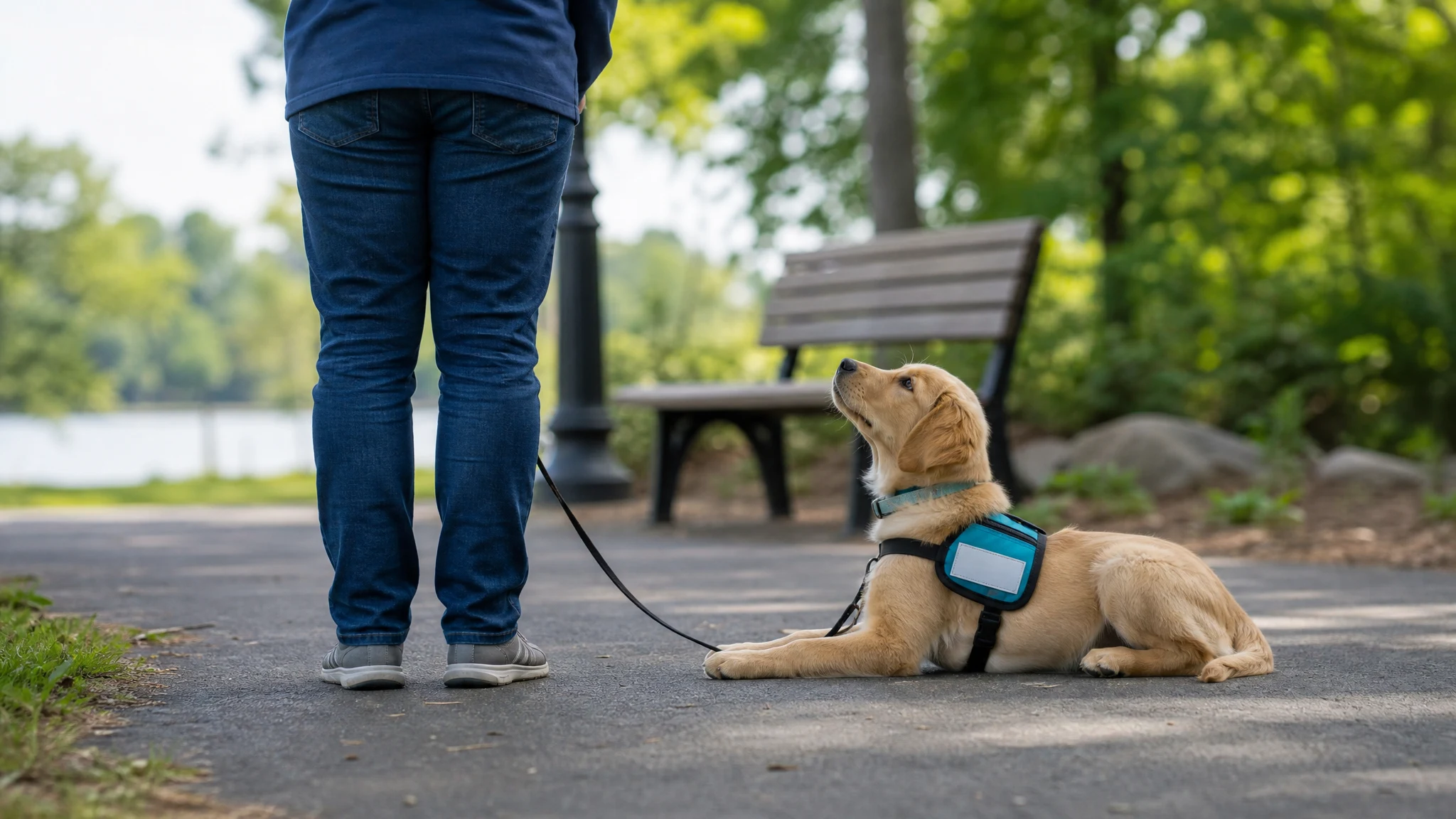
Many people with disabilities in Connecticut train their own service dogs. Some do it because program waitlists are long or unknown. Others want a dog that fits their daily life and their particular needs. If you are asking how to train a service dog yourself, the law gives you more room than most people expect, and it also draws some firm lines.
This guide walks through an owner trained service dog from start to finish. Each stage is tied to what the ADA and the Connecticut General Statutes actually say, including the limits of Connecticut's rules for dogs in training. It is a plain-English explainer, not a promise of results and not a substitute for a trainer who can see your dog in person.
Key takeaways
- The ADA defines a service animal as a dog individually trained to do work or perform tasks for a person with a disability (ADA.gov). The definition describes the dog and its training, not who did the training.
- There is no official service dog registry or required certification under the ADA. Online registrations and ID cards are not legal proof.
- Connecticut's access rules for people training animals (Conn. Gen. Stat. 46a-44) cover organization-linked trainers and volunteer raisers. A private handler training a dog at home is not described there, so do not assume in-training access in stores and restaurants.
- Use reward-based methods, in line with the American Veterinary Society of Animal Behavior (AVSAB). Bring in a professional trainer for task work.
- Emotional support, therapy and comfort animals are not service animals under the ADA.
Table of contents
- What the law says about owner training
- Stage 1: Temperament and health screening
- Stage 2: Foundation obedience
- Stage 3: Socialization
- Stage 4: Task training
- Stage 5: Public access work
- Licensing, housing, work and complaints
What the law says about owner training
The federal definition
ADA.gov says the ADA defines a service animal as a dog that has been individually trained to do work or perform tasks for an individual with a disability. Two parts of that sentence matter for owner training.
- Dog. The federal definition is dog-only.
- Individually trained to do work or tasks. A dog that simply comforts you by being near is not enough. The dog needs trained behavior that helps with your disability.
The definition does not say a program or professional must do the training. That is why owner training is a recognized path. It also means the training has to be real. A dog that has only learned to sit, stay and walk politely is a well-mannered pet, not yet a service dog.
The Connecticut definition
The Connecticut General Assembly's statutes define service animal by reference to the federal regulation, 28 CFR 35.104 (Conn. Gen. Stat. 22-327 and 22-345). Connecticut's scope therefore follows the ADA text. The state's definition also covers an animal in training to become a service animal, which is where the next point comes in.
Dogs in training: who has access rights
This is the part owner-trainers most often get wrong. Conn. Gen. Stat. 46a-44 extends access rights to any person training an animal as a service animal to assist a person with a disability. Under 46a-44(a)(2), that means:
- a person employed by an organization that trains service animals, who meets the organization's professional association membership criteria, is authorized for designated training activities and carries photo ID showing employment and authorization, or
- a volunteer for an organization that trains service animals and authorizes volunteers to raise them.
Both routes are tied to an organization. The statute as summarized does not describe a private person training their own dog at home. If you are an owner-trainer, check with the Connecticut Commission on Human Rights and Opportunities (CHRO) before relying on in-training access rights, and expect that a business may not have to admit a dog that is still in training.
For a fuller walkthrough of these rules, see our page on service dogs in Connecticut, training and access rights.
Not legal advice
This guide states what the sources say. It is not legal advice. For questions about your own situation, the CHRO is the state agency to ask (details at the end of this guide).
Stage 1: Temperament and health screening
Training cannot fix a dog that is a poor fit. Screening comes first, before you invest months of work.
What to look for in temperament
A service dog spends its working life around crowds, noise, strangers, food on the floor and other animals. Useful traits include:
- Calm recovery after a startle, rather than lingering fear.
- Friendly or neutral reactions to strangers, with no guarding or lunging.
- Interest in working with you and taking food rewards in new places.
- Steady behavior around other dogs.
A puppy from a breeder or rescue can show promise, but adult temperament is not fully predictable. Be honest if your dog is anxious or reactive. Many wonderful pets do not make service dogs, and choosing a different path for that dog is a kind decision, not a failure.
Health screening
A service dog has to stay physically sound for years of work. Ask your own veterinarian about joint, eye, heart and general health checks that suit your dog's age and breed. A dog that is in pain often behaves worse, so a health problem can look like a training problem.
The Connecticut tie-in at this stage
At this stage your dog is a pet, with a pet's legal status. Connecticut's service animal access rules do not apply to a dog you are only evaluating. Keep this stage in places where dogs are welcome, such as your home, your yard and dog-friendly venues that you have checked allow dogs.
You can also confirm the basics now. Conn. Gen. Stat. 22-345 provides a dog license and tag through the town clerk, so make sure your dog is licensed under whatever rule applies to your dog right now.
Stage 2: Foundation obedience
Foundation skills are the base for everything that follows. They are also the stage where your methods matter most.
Reward-based methods only
Use food, toys and praise to mark and reward behavior you want. AVSAB's position is that reward-based training is the approach to use, because punishment-based methods can increase fear and anxiety, which is the opposite of what a service dog needs. A service dog should want to work with you, not work to avoid a correction.
Core skills to build
- Name response and attention. The dog looks to you when you say its name.
- Sit, down and stay, held for increasing lengths of time and with distractions.
- Loose-leash walking. No pulling, no lunging at passing people or dogs.
- Reliable recall. Coming when called, even in new places.
- Settle on a mat. Lying quietly for long periods, which is the skill you will use in waiting rooms and restaurants.
- Leave it and wait. Ignoring dropped food and not rushing through doors.
- Calm handling. Accepting grooming, nail trims and vet exams without stress.
The Connecticut tie-in at this stage
Conn. Gen. Stat. 46a-44(b) lets a person with a disability keep a service animal with them at all times, at no extra charge, as long as the animal stays in the person's direct custody and control. Control is a legal condition, not only a training goal. Every skill in this stage is part of what lets you meet it later.
Practice these skills at home, then in quiet, dog-friendly spaces. Do not treat this stage as access training for stores or restaurants.
Stage 3: Socialization
Socialization means helping your dog become comfortable with the world. It is not the same as letting your dog greet everyone. A service dog must be able to ignore most people and dogs.
What good socialization looks like
- Surfaces and sounds. Tile, grates, elevators, automatic doors, sirens and traffic.
- People. Different ages, hats, uniforms, wheelchairs, canes and strollers.
- Other animals. Calm passing, without greeting or reacting.
- Vehicles. Cars, buses and trains, introduced gradually and at your dog's pace.
Keep sessions short and positive, and reward calm choices. If your dog shows fear, increase distance and make the next step easier. Pushing a worried dog through a scary situation can create a lasting problem.
The Connecticut tie-in at this stage
This is the stage where owner-trainers most want to take their dog into stores, restaurants and public buildings. Connecticut's in-training access rights in 46a-44 are written for organization-linked trainers and volunteer raisers, not for a private handler training at home. Do not assume a business must let your dog in.
Your options include:
- Practicing in outdoor public spaces and dog-friendly venues where dogs are allowed.
- Asking a business owner or manager for permission before you visit, and accepting a no.
- Working with a trainer or organization that can structure public outings.
If you are connected to a service dog organization as a volunteer raiser, the organization can tell you what its authorization covers. Confirm the details with the organization and, if needed, with the CHRO.
Stage 4: Task training
This stage is what turns a well-behaved dog into a service dog. Under the ADA, the dog must be individually trained to do work or perform tasks related to your disability. The task is the legal core of the definition.
What counts as work or a task
The work or task has to be directly related to the person's disability. ADA.gov's service animal guidance gives categories such as guiding people who are blind, alerting people who are deaf, pulling a wheelchair, and reminding a person to take medication or interrupting behaviors for people with psychiatric disabilities. Your tasks will depend on your disability and needs. Examples of the kind of work involved include retrieving dropped items, providing balance support, or alerting to a specific change.
What does not count is the dog's presence alone. Emotional support, therapy and comfort animals are not service animals under the ADA, because they are not individually trained to perform tasks. Keep this distinction exact in your own mind, because businesses will ask about it.
Why to hire a professional trainer for tasks
Foundation obedience is something many owners can teach well with good instruction. Task training is harder. A task has to be reliable, specific and safe, and some tasks affect your health if they fail. A professional trainer who uses reward-based methods can:
- Break the task into small steps your dog can learn.
- Spot mistakes in timing and rewards early.
- Help you proof the task in distracting places.
- Tell you honestly if your dog is not suited to a particular task.
When choosing a trainer, ask about their methods directly. Look for reward-based training consistent with AVSAB's guidance, and move on from anyone who uses punishment-based tools or dominance ideas. This guide cannot name trainers for you. Ask for references and watch a session first.
The Connecticut tie-in at this stage
Connecticut adopts the federal definition, so the task requirement is the same in state law as in the ADA. Documenting your training is not a legal requirement, but keeping notes on tasks and dates can help you answer questions clearly.
Ask each program or trainer what they provide and what it costs. Cost and waitlist details were not published on the pages checked for several Connecticut-serving organizations, including ECAD in Torrington, Forever In My Heart Foundation in Rocky Hill and The Exceptional Sidekick Service Dogs in Newtown, so check directly with each one.
A note for veterans
The U.S. Department of Veterans Affairs offers a service dog benefit for guide, hearing or mobility service dogs. For that benefit, the dog and veteran must complete training from an organization accredited by Assistance Dogs International or the International Guide Dog Federation and give VA a completion certificate. An owner-trained dog may not fit that pathway. Veterans should speak with a VA clinical care provider before starting if the benefit matters to them.
Stage 5: Public access work
Public access training comes last because it asks your dog to do everything at once: stay calm, stay focused and perform tasks if needed, in places full of distractions.
Skills to proof in public
- Walking beside you through crowds without sniffing, pulling or greeting.
- Settling under a table or chair for a whole meal or appointment.
- Ignoring dropped food, other dogs and people who try to pet or call to it.
- Staying quiet. Barking is not part of a service dog's job.
- Performing trained tasks on cue or on signal, even when distracted.
- Toileting on cue and staying clean in public buildings.
Build up slowly. Start with a quiet errand, then a busier one. End each outing before your dog is worn out, and give breaks when you need them.
What businesses may ask
ADA.gov says that when it is not obvious that a dog is a service animal, staff may ask only two questions:
- Is the dog a service animal required because of a disability?
- What work or task has the dog been trained to perform?
Practice a short, calm answer to the second question. Staff may not ask for documentation, so there is nothing to show. There is no official registry or required certification under the ADA, so a certificate or ID card bought online is not proof of anything under the law. Do not buy one, and do not rely on one.
The Connecticut tie-in at this stage
Once your dog has been individually trained to do work or tasks for you, it is a service animal under the federal definition that Connecticut adopts. The Connecticut General Assembly's statutes then give you these protections:
- Under 46a-44(b), you may ride public transportation and enter places of public accommodation with your service animal and keep it with you at all times at no extra charge, provided it stays in your direct custody and control.
- Under 46a-64, refusing entry to a person with a disability accompanied by a service animal is a discriminatory practice, and a violation is a class D misdemeanor.
- Under 46a-44(d), intentionally interfering with the use of a service animal by a person with a disability is a class C misdemeanor.
Direct custody and control cuts both ways. A business may have a lawful reason to ask that a dog be removed if it is out of control. A dog that barks, lunges or wanders risks your access and the access of every other handler.
On misrepresentation, no Connecticut penalty was found in the sources reviewed for this guide. Check with the CHRO or the General Assembly's current statutes if you have a question about it, and do not describe your dog as a service animal until it has been trained to perform tasks.
Licensing, housing, work and complaints
Dog license
Conn. Gen. Stat. 22-345 gives the owner of a service animal a license and tag from the town clerk with no fee. The clerk may ask whether the dog is a service animal. No state registry, ID card or certification program was found in the statutes reviewed. A 2025 registration bill appeared in search results but its outcome was not confirmed, so check the General Assembly's site for current law.
Housing
Conn. Gen. Stat. 46a-64c prohibits disability-based discrimination in the sale or rental of a dwelling. It treats a refusal to make reasonable accommodations in rules, policies, practices or services as discrimination, and a violation is a class D misdemeanor. The text read does not name service animals or assistance animals, so a request to live with one is handled as a reasonable accommodation request. The federal agency for housing is the U.S. Department of Housing and Urban Development (HUD). Statute text for this section was read through a third-party legal site that may lag the current law, so confirm the current wording.
Employment
Conn. Gen. Stat. 46a-60(b)(1) bars employment discrimination because of a present or past history of mental disability, intellectual disability, learning disability or physical disability. The text read does not mention service animals. A request to bring a service dog to work would be an accommodation question under that section and the ADA.
Where to take a complaint
The Connecticut Commission on Human Rights and Opportunities (CHRO) handles complaints in employment, housing and places of public accommodation. A formal complaint must be filed within 300 days of the discriminatory act.
- Statewide toll-free: 800-477-5737
- Capitol Region office: 450 Columbus Boulevard, Suite 2, Hartford, CT 06103-1835, 860-566-7710
- File online: portal.ct.gov/chro/file-complaint
A realistic plan
Owner training takes many months and varies a lot by dog and by handler. No method guarantees that a given dog will finish. A workable plan looks like this:
- Screen the dog's temperament and health before you commit.
- Teach foundation skills with reward-based methods.
- Socialize carefully, within the limits of where dogs may legally go.
- Hire a professional trainer for task work.
- Proof the dog in public, then use the protections the law gives a trained service animal.
If your dog is not able to complete the path, that is information, not a failure. Many handlers then turn to a program, and the dog stays a loved pet.
Sources
- ADA.gov, Frequently Asked Questions about Service Animals and the ADA
- Connecticut General Assembly, 2025 General Statutes, Chapter 814b (Sec. 46a-44)
- Connecticut General Assembly, 2025 General Statutes, Chapter 814c (Secs. 46a-64 and 46a-64c)
- Connecticut General Assembly, 2025 General Statutes, Chapter 435 (Secs. 22-327 and 22-345)
- Conn. Gen. Stat. 46a-60, employment discrimination (FindLaw)
- Connecticut Commission on Human Rights and Opportunities, file a complaint
- U.S. Department of Veterans Affairs, service dog benefits