Service Dog Tasks and the Public Access Test, Explained
This page explains the law in general terms. It is not legal advice. For a specific situation, contact the agency listed on this site or an attorney.
Two ideas get mixed up more than any others in service dog training. One is what counts as a task. The other is what a public access test does and does not prove.
This guide covers both for handlers in Connecticut. It explains what the ADA means by work or tasks and how to build a task list for your own situation. It also shows how to use a public access test as a practice benchmark. The test is a training tool, not a legal requirement.
The short version
- ADA.gov says the ADA defines a service animal as a dog that has been individually trained to do work or perform tasks for an individual with a disability.
- Comfort, companionship and a calming presence are not tasks. Emotional support, therapy and comfort animals are not service animals under the ADA.
- A public access test is a training benchmark. The ADA does not require a dog to pass one, and there is no official service dog registry or required certification under the ADA.
- Connecticut defines a service animal by reference to the federal ADA regulation, so the state follows the same dog-only, task-based definition.
What counts as a task under the ADA
The ADA test has two parts. The handler has a disability, and the dog has been individually trained to do work or perform tasks for that person. The training has to connect to the disability. A dog that does something useful for a person is not enough on its own. The dog must have been taught to do it because of the disability.
A useful way to think about it is cause and effect. Start with a specific difficulty the disability creates. Then ask what action the dog is trained to perform on cue or in response to a trigger. If you can write that sentence plainly, you have a task.
Examples of tasks by disability
The lists below are common illustrations, not a legal list. For the official federal discussion, read the ADA.gov Frequently Asked Questions about Service Animals and the ADA, linked in the sources below.
| Type of disability | Example of a trained task |
|---|---|
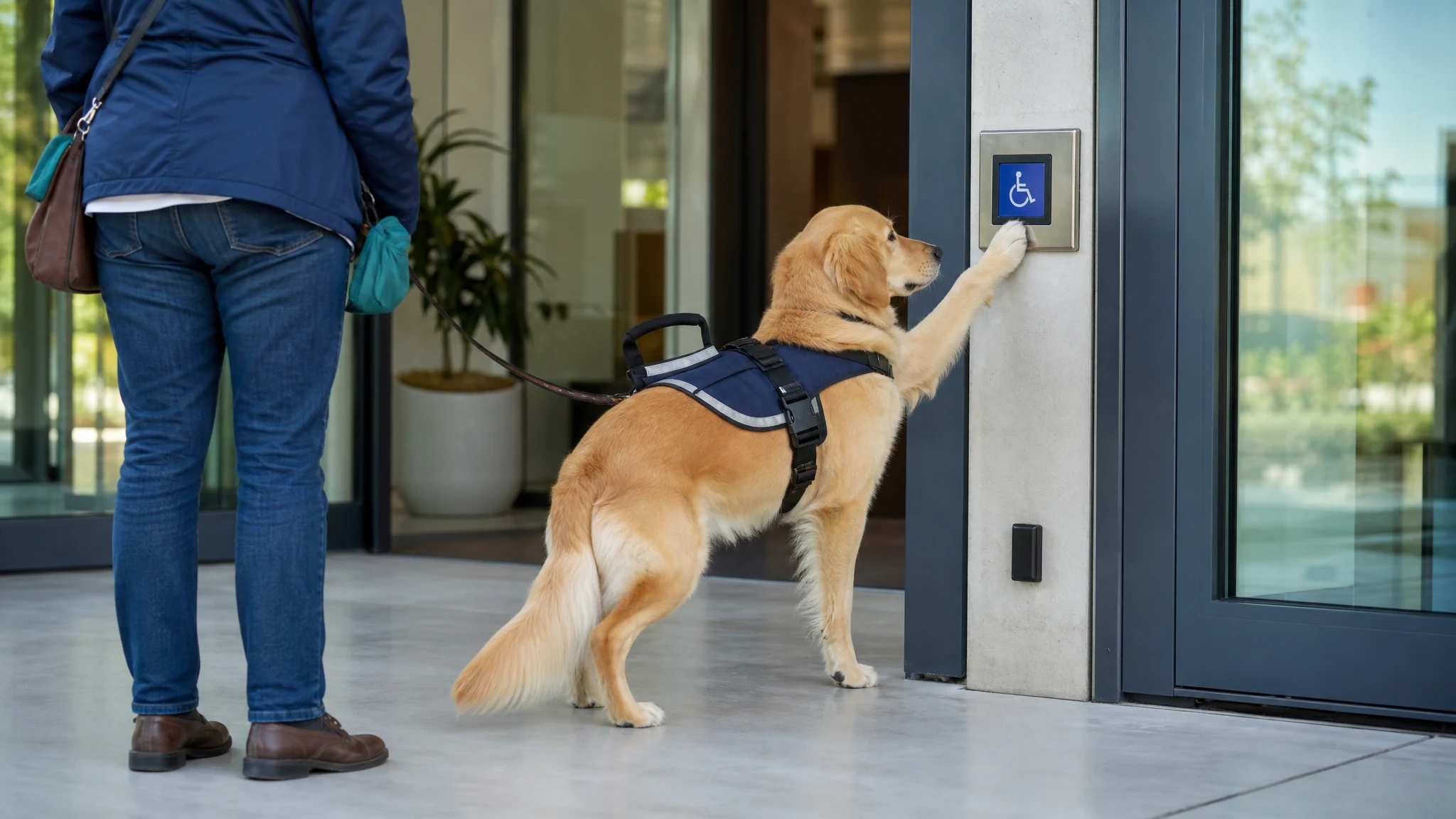
| Mobility | Retrieving dropped items, opening doors, or bracing so the handler can stand |
| Vision | Guiding the handler around obstacles and stopping at curbs and steps |
| Hearing | Alerting the handler to a sound, such as a smoke alarm or a knock |
| Medical (for example, seizures or blood sugar changes) | Alerting to a change, or fetching a phone or medication |
| Psychiatric (for example, PTSD) | Interrupting a harmful repetitive behavior, or turning on lights and checking a room on cue |
| Autism | Interrupting a repetitive behavior, or keeping a child from bolting into a hazard |
If you are asking what tasks a service dog can do, the honest answer is that the range is wide. It depends on the person's disability and the individual dog's training. A task list that fits one handler may not fit another.
Why comfort alone is not a task
Many people love their dogs, and many dogs help their owners feel better. That is real, and it still does not make a dog a service dog under the ADA.
ADA.gov draws the line at work or tasks that the dog is individually trained to perform. A dog that comforts by being present, without a trained action tied to the disability, is an emotional support or comfort animal. Those animals are not service animals under the ADA.
Psychiatric service dogs are not the same as emotional support animals. A psychiatric service dog performs a trained action, such as interrupting a panic response on cue. A dog that simply makes its owner feel calm does not meet that standard.
The public access test as a training benchmark
A public access test checks how a dog behaves in ordinary public places, such as a store, a sidewalk or a restaurant. Assistance dog organizations use tests like this to decide whether a dog is ready to work in public. Assistance Dogs International is the best-known standard-setting body, and its public access test is a common model.
The test is not a legal requirement under the ADA. Nobody can lawfully demand that a dog pass a test, hold a certificate or show an ID card. If you want the current ADI test items and scoring, check with Assistance Dogs International directly.
The benchmark is still worth using. It gives you an honest way to find the gaps in your dog's training before they show up in a crowded place. Passing a practice run does not prove a legal status, and it does not guarantee how your dog will act on the next outing.
How to build tasks and practice for a public access test
Materials you will need
- A training notebook or phone notes to keep a task list and a session log
- Small, soft treats your dog loves, plus a toy or praise as backup rewards
- A well-fitted flat collar or harness and a standard leash
- A mat or blanket that can travel with you
- A friend or family member to act as a distraction
- A list of practice locations, starting with quiet ones
Step 1: Write down the need, then the task
Start with the disability-related difficulty, not the trick. Write one line such as: "When I cannot reach an item on the floor, my dog picks it up and puts it in my hand." Each line should name the difficulty and the action.
If a line only says "calms me" or "keeps me company," it is not a task yet. Rewrite it as a specific action, or drop it from the list.
Step 2: Teach each task with rewards
Teach tasks in small steps and pay your dog for every correct attempt. Reward-based methods are in line with the American Veterinary Society of Animal Behavior (AVSAB). Do not use shock, prong or choke collars, alpha rolls, scruffing or dominance methods. They add fear and can damage the working relationship.
Practice in short sessions. A few minutes, ended on a success, usually works better than one long, tiring session.
Step 3: Add a cue or trigger
Some tasks are done on a verbal or hand cue. Others are done in response to a trigger, such as a sound or a change in the handler's behavior. Decide which kind each task is, and train it that way from the start.
Step 4: Build the basic manners behind the tasks
Tasks only help if the dog can stay calm and controlled around them. Work on loose-leash walking, sit, down, stay, coming when called and settling on a mat. Teach the dog to ignore dropped food and other dogs.
Connecticut law adds a practical reason. Under Conn. Gen. Stat. 46a-44(b), a person with a disability may take a service animal onto public transportation and into places of public accommodation, as long as the animal stays in the person's direct custody and control. Good manners are how you meet that expectation.
Step 5: Proof the skills in new places
A dog that sits perfectly in the living room may fall apart in a store. Move in small steps: your yard, a quiet street, a hardware store at an off-peak hour, then busier spots. Keep sessions short and leave before your dog is overwhelmed.
Public access skills often include these items. Treat them as a practice list, and check ADI for its exact version:
- Walking calmly beside the handler through doorways and crowds
- Staying settled under a table or beside a chair
- Ignoring food, people and other animals
- Waiting while the handler pays or talks
- Staying calm around unexpected noises
- Staying clean and under control while out
Step 6: Run a practice test and log the results
Pick a route with several of the situations above. Ask your helper to create small distractions. Write down what went well and what did not, without judging your dog harshly.
Repeat the run after a few weeks of work on the weak spots. The log shows your progress better than memory does.
Step 7: Know your rights and the questions you may be asked
Under the ADA, when it is not obvious that a dog is a service animal, staff may ask only two questions, according to ADA.gov. First, is the dog a service animal required because of a disability? Second, what work or task has the dog been trained to perform?
Your task list from Step 1 prepares you for the second question. A short, plain answer is enough. You do not need paperwork.
Connecticut points to know
Connecticut law follows the federal definition. The General Assembly's statutes refer to the federal regulation, 28 CFR 35.104, and the state definition also covers an animal in training to become a service animal.
Section 46a-64 makes it a discriminatory practice to refuse entry to a person with a disability accompanied by a service animal. A violation is a class D misdemeanor. Under 46a-44(d), intentionally interfering with the use of a service animal by a person with a disability is a class C misdemeanor.
On training access, Section 46a-44 extends access rights to people training an animal as a service animal, but only in set cases. These are people employed by an organization that trains service animals and who meet the statute's conditions, and volunteers for an organization that trains service animals and authorizes volunteers to raise them. That language covers organization-linked trainers and volunteer raisers, not every private handler. For more on how this works, see our guide to service dogs in Connecticut, including training and access rights.
Connecticut has no state registry, ID card or certification program that we found. The one state-level step is the ordinary dog license. Under Section 22-345, the owner of a service animal receives a license and tag from the town clerk at no fee, and the clerk may ask whether the dog is a service animal. Check with your town clerk for current procedure.
Tips and common mistakes
- Calling comfort a task. Always tie the action to the disability. If it only soothes, it is not a task under the ADA.
- Treating the test as a license. A passed practice test is useful feedback. It is not legal proof of anything.
- Buying a registration or ID. The ADA has no registry or required certification. An online certificate is not legal proof, so skip those sellers.
- Jumping to busy places too fast. Rushing can teach a dog to shut down or react. Go slowly and leave while your dog is still doing well.
- Using harsh corrections. Shock, prong and choke tools and dominance methods go against AVSAB guidance and can harm your dog's confidence.
- Skipping rest. Working dogs need downtime, play and sleep. A tired dog makes more mistakes.
- Not keeping a log. Notes make patterns visible and help you explain the dog's trained tasks plainly if you are asked.
Expected results
With steady, reward-based practice, many handlers find their dog becomes more reliable at its tasks and more settled in public. Progress varies by dog, by task and by how much practice time you have. Some tasks take weeks and others take many months.
A practice test may help you see where your dog is strong and where it needs more work. It does not guarantee how the dog will behave in every place, and it does not decide whether the dog is covered by the ADA. If you are working with an organization, ask what it expects from you.
If you are turned away
If a business, employer or landlord treats you unfairly because of a service dog, the Connecticut Commission on Human Rights and Opportunities (CHRO) handles complaints about employment, housing and places of public accommodation. A formal complaint must be filed within 300 days of the discriminatory act. The CHRO statewide toll-free number is 800-477-5737. This article states the law and is not legal advice, so contact the agency with questions about your own situation.
Sources
- ADA.gov, Frequently Asked Questions about Service Animals and the ADA
- Connecticut General Assembly, 2025 General Statutes, Chapter 814b, Sec. 46a-44
- Connecticut General Assembly, 2025 General Statutes, Chapter 814c, Sec. 46a-64
- Connecticut General Assembly, 2025 General Statutes, Chapter 435, Secs. 22-327 and 22-345
- Connecticut Commission on Human Rights and Opportunities, file a complaint